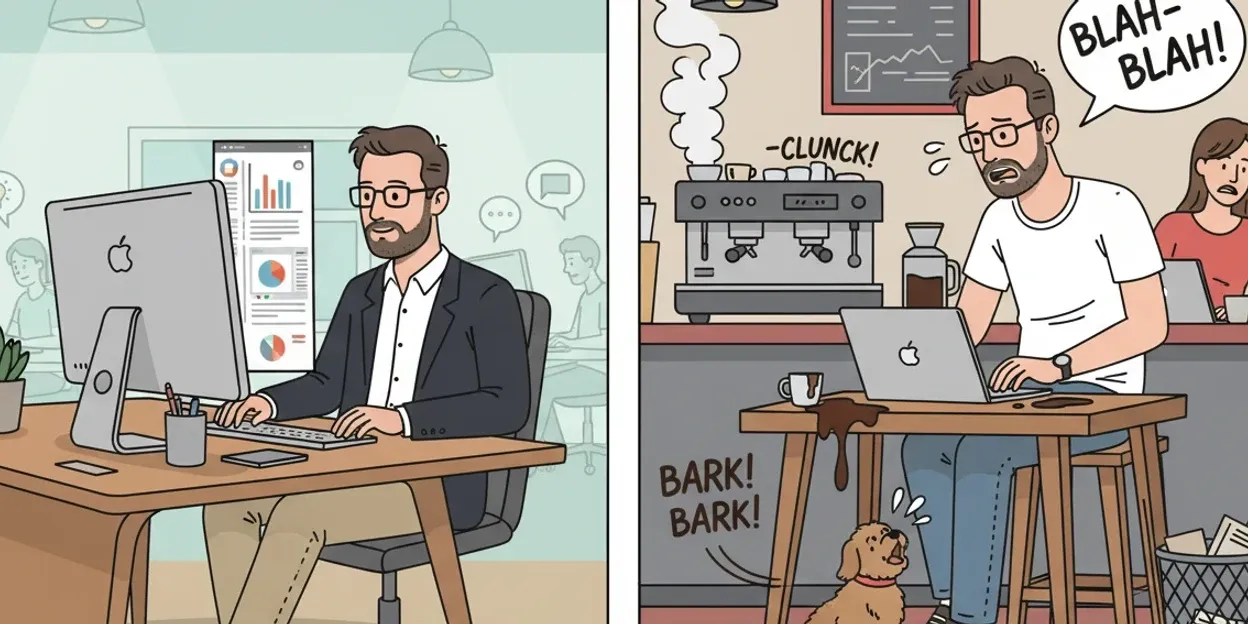
most people ask for remote work in the weakest possible way.
they wait until they are frustrated, then they say something like:
“i was wondering if i could work from home more.”
or:
“i am thinking about traveling for a while and wanted to see if that would be okay.”
it is honest. it is also the wrong frame.
the moment the conversation becomes about what you want, your manager has to think about policy, fairness, precedent, payroll, security, other employees, and whether saying yes to you creates a headache they do not need.
you do not want that conversation.
the better conversation is:
“i think i can produce better work with fewer interruptions. i would like to run a measured remote trial so we can test it without making a permanent decision today.”
that is not a vibe.
that is a proposal.
the remote-work reality in 2026
remote work is not gone. it is just less loose than it was in 2020.
that distinction matters.
Gallup’s 2025 data on remote-capable U.S. employees showed 28% working exclusively remote, 51% hybrid, and 21% fully onsite in Q2 2025. In other words, among jobs that can be done remotely, most people are not fully office-bound.
At the same time, fully remote roles are more competitive. LinkedIn’s 2025 Remote Work Gap report found that demand for remote roles stayed relatively strong while the supply of remote opportunities fell more sharply after the pandemic peak.
so if you already have a good job and a manager who trusts you, negotiating remote may be easier than replacing your job with a fully remote one.
there is also a good evidence base now. A large randomized trial published in Nature studied hybrid work at Trip.com. Employees who worked from home two days per week did not show worse performance or promotion outcomes, and quit rates fell by about one-third.
this does not prove every job can be remote.
it does prove that “remote automatically destroys productivity” is not a serious argument anymore.
the stronger question is: can your role be managed remotely without creating risk for the team?
that is the question your proposal has to answer.
what your manager is actually worried about
you might think the objection is trust.
sometimes it is.
but usually it is a bundle of smaller worries:
- will you still be reachable?
- will other people ask for the same thing?
- will collaboration get slower?
- will your output become harder to see?
- will HR or legal care where you are working?
- will clients notice?
- will timezone differences become annoying?
- will your manager look careless if this goes badly?
your job is not to argue that these worries are stupid.
some of them are real.
your job is to make the yes feel safer than the no.
that is the whole negotiation.
do the pre-work before you ask
before you book the meeting, write a one-page remote trial plan.
not a manifesto. not a deck.
one page.
include these sections.
1. the proposed trial
“six weeks, fully remote, same working hours, same meeting cadence, same deliverables.”
if fully remote is too big a jump, ask for three remote days per week first.
do not overreach if the company has never done this before.
2. your success metrics
choose metrics your manager already cares about.
examples:
- tickets closed
- client response time
- project milestones shipped
- sales calls completed
- proposal turnaround time
- weekly deliverables
- stakeholder feedback
- bugs resolved
- campaign assets delivered
- reporting cadence maintained
avoid vague metrics like “focus” unless you connect them to output.
“i will be more focused” is a feeling.
“i will send a Friday summary of shipped work, blockers, and next-week priorities” is evidence.
3. communication rules
write down:
- core overlap hours
- response expectations
- meeting availability
- escalation channel
- how you will handle urgent issues
- what happens if internet fails
most remote anxiety is really communication anxiety.
remove it upfront.
4. compliance boundaries
this is especially important if you want to become a digital nomad.
do not casually say “i will be working from wherever.” that phrase makes HR people see paperwork.
start with one approved location if you can.
for example:
“for the trial, i will work from my current home address.”
then, once remote is approved and proven, you can discuss travel, timezones, tax, security, and country restrictions properly.
i know this feels slower.
slower is why it works.
5. the review date
put the review on the calendar before the trial starts.
“at the end of week six, we review the evidence and decide whether to continue, adjust, or stop.”
that gives your manager an exit.
people say yes more easily when no is still available later.
the script
say it plainly.
something like this:
i have been looking at where my best work is happening, and i think there is a case for testing a remote setup. i do not want to ask for a permanent change without evidence, so i would like to propose a six-week trial.
during the trial, i would keep the same meetings, same availability, and same output expectations. i would also send a short weekly summary with what shipped, what is blocked, and what is coming next. at the end of six weeks, we review whether performance, communication, and team coordination are at least as good as they are now.
if it is not working, we stop or adjust. if it is working, i would like to discuss making it permanent.
then stop talking.
this part is hard.
do not fill the silence with travel dreams, personal frustration, or a speech about the future of work.
let your manager respond to the actual proposal.
what to say when they ask why
you need a reason, but it should be work-first.
good reasons:
- fewer interruptions for deep work
- better control of meeting-heavy days
- improved focus for writing, analysis, design, engineering, or client work
- better energy management without commute fatigue
- ability to create a more consistent work environment
weak reasons:
- i want freedom
- i want to travel
- everyone else gets to
- offices are pointless
- i work better at home, trust me
you are allowed to want freedom.
just do not make your manager carry that as the business case.
the weekly proof document
this is where most people lose the negotiation after getting the trial.
they get approved, disappear into remote work, then assume everyone can see that things are fine.
they cannot.
remote work has less ambient visibility. you have to replace that with intentional visibility.
every Friday, send a short update:
shipped
- project A moved from draft to client review
- closed 14 support tickets, average first response 38 minutes
- delivered Q2 reporting deck
in progress
- project B waiting on finance numbers
- candidate shortlist ready for Monday review
blockers
- need decision on vendor budget by Tuesday
next week
- finalize onboarding doc
- run client renewal call
- publish dashboard update
this email should take 10 minutes.
it does two jobs:
- it makes your work visible
- it makes your manager feel in control
that second part matters more than people admit.
how to handle common objections
”if we allow this for you, everyone will ask”
say:
“that makes sense. i am not asking to change the company policy today. i am asking to test whether this specific role and performance history can support a remote arrangement. if the concern is precedent, we can document the conditions that make this a trial rather than a blanket rule.”
you are separating your case from a universal policy.
”collaboration will suffer”
say:
“let’s define what collaboration needs to look like. i can keep the same meetings, same core hours, and use a shared project doc so work is visible. if any collaboration metric gets worse during the trial, we treat that as a reason to adjust.”
make the concern measurable.
”the policy does not allow it”
say:
“who would need to approve an exception or pilot? i am happy to write the proposal in the format they need.”
do not make your manager do all the admin.
”we need people in the office”
ask:
“which parts of my role specifically require physical presence?”
then be quiet.
if they can name real reasons, address them.
if they cannot, you have learned something.
”how do we know you will be working?”
say:
“the same way we know now: output, responsiveness, and stakeholder feedback. i am happy to make those more visible during the trial.”
do not agree to invasive monitoring unless you are truly comfortable with it.
NBER’s 2025 work-from-home research found many firms do not closely track onsite compliance or WFH amounts anyway. In practice, serious managers care about whether work gets done.
when to bring up travel
not in the first meeting.
first, get remote approved.
then prove it works.
then talk about location flexibility.
there are real reasons companies care where you work:
- payroll registration
- tax exposure
- employment law
- client contracts
- data security
- insurance
- export controls
- timezone coverage
if you pretend those are fake, you sound immature.
better:
“now that the remote arrangement is working, i would like to understand what location boundaries the company is comfortable with. are there countries or timezones i should avoid for legal, tax, security, or client reasons?”
that sentence is boring.
boring is good.
boring gets approved.
if the trial works, get it in writing
do not build a life around a Slack message.
if your company agrees to make remote permanent, ask for written confirmation.
depending on the company, that might be:
- contract addendum
- HR letter
- remote-work agreement
- email from HR and your manager
- policy exception note
you want the document to cover:
- remote status
- expected location or location limits
- timezone expectations
- office visit expectations
- review cadence
- equipment or security rules
this matters because managers leave.
policies change.
new executives arrive and decide culture lives in badge-swipe data.
written terms do not make you invincible, but they make the conversation much harder to casually reverse.
when to stop negotiating
stop if the company gives you a clear cultural no.
not a practical no. a cultural no.
practical no:
“we need client coverage in this timezone.”
“we need you onsite for these two meetings each month.”
“we can only approve domestic remote work.”
these can be worked with.
cultural no:
“we just believe people work better in the office.”
“leadership wants everyone visible.”
“it would send the wrong message.”
“we are not that kind of company.”
you can spend months fighting that, or you can spend those months finding a company already designed for the life you want.
do not confuse persistence with strategy.
the strongest long-term move
if you want to become a digital nomad, the best credential is not a course.
it is a year of excellent remote performance.
one year where you can say:
- i worked across timezones
- i hit deadlines without office supervision
- i communicated clearly
- i managed stakeholders remotely
- i stayed employed and useful
that makes your next remote role easier.
it makes freelancing easier.
it makes your own confidence real instead of theoretical.
so yes, negotiate the trial.
but understand what you are really negotiating for.
not just permission to work from home.
proof that your career can travel.
what to do next
Before you ask for remote work, build the smallest credible trial:
- write a six-week proposal with the same meetings, clearer outputs, and a review date
- collect recent proof: shipped work, response times, stakeholder feedback, and deadlines hit
- name your manager’s likely risks: fairness, coverage, security, performance, and precedent
- ask for a reversible trial before asking for a permanent exception
- send a weekly proof document during the trial so the decision has evidence attached
The goal is not to win a remote-work argument. The goal is to make yes feel measured, boring, and low-risk.