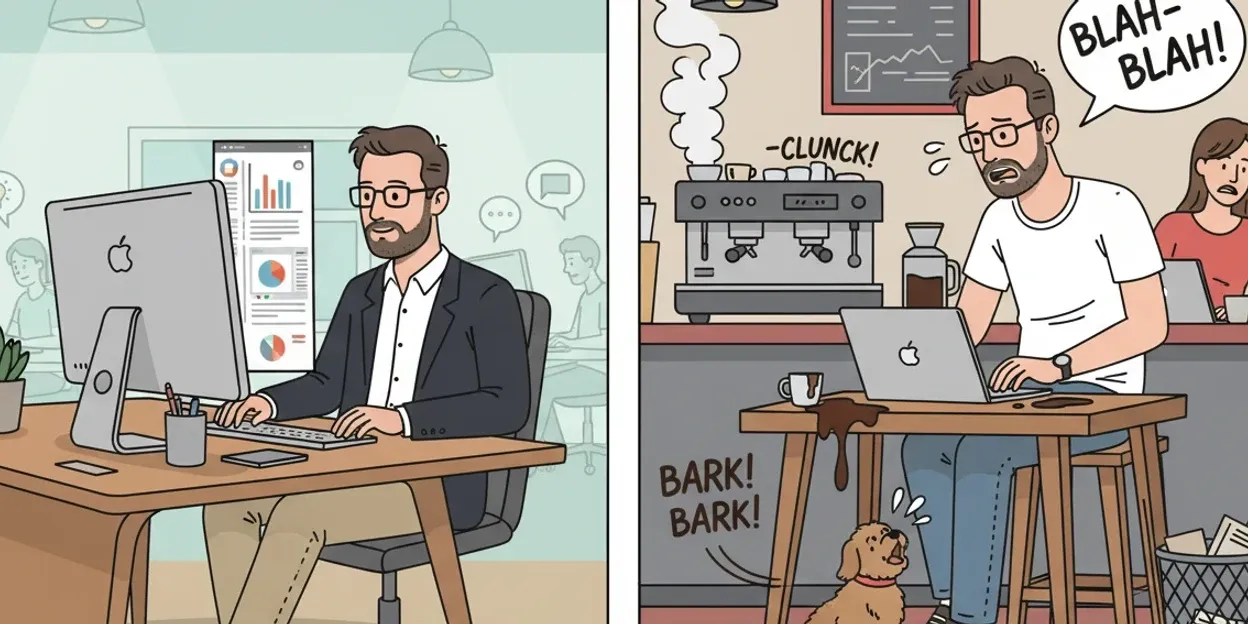
the internet version of digital nomad life has a very specific rhythm.
new city. new cafe. new rooftop. new carry-on photo. new “how is this my life?” caption.
then another airport.
then another apartment where the desk is actually a decorative shelf.
then another Monday morning call where you are pretending the wifi is fine.
i did this version for a while. not forever, but enough to learn the lesson.
one-week stays are exciting for about three weeks.
then they become admin with better weather.
if you are working full-time, building a business, or trying to keep a serious career intact, one-month stays beat one-week sprints almost every time.
not because slow travel is morally superior.
because it is operationally better.
the hidden cost of moving every week
a seven-day stay sounds like seven days in a city.
it is not.
it is usually:
- day 1: travel, check-in, groceries, wifi test, mild confusion
- day 2: first real work day, still figuring out the apartment
- day 3: maybe a decent rhythm
- day 4: laundry, neighborhood, coworking trial
- day 5: finally comfortable
- day 6: start thinking about leaving
- day 7: pack, clean, transport, next place
you get maybe two good normal days.
the rest is setup and teardown.
this is fine if you are on vacation.
it is brutal if you are trying to have a job.
work does not pause because you wanted a more interesting backdrop. your clients still expect replies. your manager still expects you to be useful. your body still needs sleep, food, movement, and some sense of where the laundry detergent lives.
the problem is not travel.
the problem is transition density.
too many resets too close together.
day 8 is where the place starts to work
there is a point i notice in almost every new city.
around day 8, something changes.
the city stops being content and starts becoming infrastructure.
you know which cafe is actually quiet. you know which grocery store has normal prices. you know the route to the gym. you have tested the coworking space. you know when the street gets loud. you have one meal you can cook without thinking.
you are not settled exactly.
but you are no longer spending the whole day interpreting.
that matters more than people think.
most new nomads underestimate the cognitive load of small decisions:
- where do i buy water?
- can i drink the tap water?
- which ATM is safe?
- why is the washing machine yelling at me in Portuguese?
- where can i take a call without a blender in the background?
- what neighborhood am i in again?
none of these are dramatic.
all of them cost attention.
the longer you stay, the more those decisions disappear into routine.
routine is not the enemy of freedom.
routine is what lets freedom function.
the work case for one-month stays
if you are already financially independent, ignore this part and enjoy your ferry schedules.
for everyone else: work is the anchor.
slow travel protects the anchor.
remote work has become normal enough that you do not need to justify it as a weird lifestyle. The 2025 NBER work-from-home research found that U.S. employees work from home about one day per week on average across firms, and businesses expect that average to stay roughly stable. Gallup’s 2025 data also shows hybrid is the dominant model for remote-capable U.S. workers.
but “remote” does not automatically mean “easy from anywhere.”
there is a big difference between:
“i work remotely from a stable apartment with tested internet and normal sleep.”
and:
“i work remotely from whatever table i found after a late flight.”
with a month-long stay, by week two you can usually stabilize:
- sleep schedule
- work hours
- desk setup
- internet backup
- coworking backup
- food routine
- exercise
- meeting locations
- social plans
with one-week stays, you are constantly doing first-week work.
and first-week work is expensive.
not always in money. often in attention.
attention is the thing you need for actual work.
the money case
fast travel is usually more expensive than people admit.
not because each city is expensive.
because transitions are expensive.
every move adds:
- airport or train transfer
- cleaning fees
- short-stay pricing
- eating out while you settle
- replacement items
- coworking day passes
- luggage storage
- mistakes made while tired
longer stays give you more leverage.
Airbnb reported that long-term stays of 28 days or more accounted for 19% of gross nights booked in Q4 2023, and about a quarter of long-term nights were for stays of three months or longer. That does not mean Airbnb is always the best place to book. It means the market has clearly adapted to people staying longer.
for month-long housing, check:
- Airbnb monthly discounts
- local Facebook housing groups
- expat and digital nomad groups
- local rental platforms
- coworking or coliving packages
- serviced apartments
- direct extensions with a host after a short initial booking
my usual approach:
- book 5 to 7 nights first
- inspect the neighborhood and wifi in person
- ask about a 30-day direct extension
- compare against local listings before saying yes
this avoids the classic mistake: paying for a full month in an apartment that looked fine online but has nightclub bass through the wall every Thursday.
beautiful photos do not show bass.
the social case
fast travel makes you meet people.
slow travel lets you know them.
that is the difference.
the loneliness problem is usually not a lack of people. it is a lack of continuity.
in a one-week stay, most social life is first conversations:
where are you from?
how long are you here?
what do you do?
where are you going next?
it is pleasant. it is also thin after a while.
with a month, you start getting second and third conversations.
you see the same person at coworking. you go to the same class twice. someone remembers your name. you get invited to something that was not posted in a WhatsApp group with 900 strangers.
none of this guarantees deep friendship.
but it creates continuity.
continuity is what most nomads are actually missing when they say they feel lonely.
not people.
continuity.
the health case nobody wants to talk about
moving every week messes with your body in boring ways.
sleep gets weird. meals get improvised. workouts disappear. alcohol becomes too easy because every new city feels like a reason to celebrate. you walk a lot, but not always in a way that makes you feel strong.
then you blame the lifestyle.
often it is not the lifestyle.
it is the pace.
with one-month stays, you can build normal health defaults:
- same wake time most weekdays
- groceries by day 2
- gym or class by day 4
- two easy meals you can repeat
- one walk route
- one quiet work spot
- one real rest day each week
not glamorous.
useful.
i have never met a burned-out nomad whose main problem was “too much routine.”
how to choose a good one-month base
do not choose only by vibe.
choose by friction.
ask these questions.
can i work normal hours here?
timezone comes first.
if your calls are in New York time, Southeast Asia might be possible for a month, but it will tax you. if your team is in Europe, Latin America may turn your evenings into workdays.
you can do almost anything for one week.
you cannot build a calm life around permanent sleep debt.
can i live without a car?
for a first month, walkability is underrated.
you want groceries, pharmacy, gym, coffee, and workspace within easy reach.
the less friction between you and normal life, the faster you settle.
is there a backup workspace?
do not trust one wifi connection.
before booking a month, identify:
- one coworking space
- one cafe with stable wifi
- one mobile data option
if you have client calls, test all of them before you need them.
is the neighborhood livable, not just cool?
cool neighborhoods can be terrible places to work.
ask about:
- noise
- construction
- hills if you walk everywhere
- late-night bars
- safety after dark
- grocery access
- desk and chair quality
the perfect area for a weekend may be the wrong area for a work month.
the first 72 hours of a month-long stay
this is the part that makes the month work.
do not just arrive and drift.
day 1:
- unpack fully
- test wifi
- buy groceries
- find drinking water
- mark pharmacy, ATM, and supermarket on the map
day 2:
- work a normal day
- test your video-call setup
- take a walk after work, not before you finish work
day 3:
- visit coworking or backup cafe
- do laundry or figure out where it is
- join one local group
- choose a repeatable weekday lunch or dinner
this sounds painfully domestic.
good.
digital nomad life is mostly normal life in different places.
if you cannot make normal life work, the postcard part will not save it.
when one-week stays do make sense
i am not religious about this.
short stays can make sense when:
- you are scouting a city before committing to a month
- you are between two longer bases
- you are actually on vacation
- you have a light work week
- you are visiting friends
- you are doing a specific event or conference
the problem is not a one-week stay.
the problem is building your whole life out of one-week stays and wondering why you feel fried.
use short stays as punctuation.
not the sentence.
the real tradeoff
slow travel means you will see fewer places.
that is the deal.
in a year, one-month stays might give you 8 to 10 real bases after accounting for visits home, holidays, and practical gaps.
one-week stays can give you 30 or 40 cities.
but you will not experience 40 cities deeply while working full-time.
you will mostly pass through them.
there is nothing wrong with passing through if that is what you want.
just call it what it is.
for me, the better version is:
- fewer airports
- fewer check-ins
- fewer bad desks
- more regular work
- more repeat meals
- more second conversations
- more days where life feels quietly good
not every day has to be a story.
some days can just work.
that is the underrated part.
my rule now
four weeks minimum.
six to eight weeks if i already know the city is good.
three months if the visa, housing, and season all line up.
i still do short trips. i still get curious. i still sometimes make the dumb choice because the flight is cheap and the weather looks good.
but when i want my life to feel stable, i stay longer.
give yourself a month.
see what changes after day 8.
what to do next
For your next working stay, choose the month before you choose the fantasy:
- pick one base for at least four weeks
- verify internet, workspace, grocery access, laundry, and timezone overlap before booking
- plan the first 72 hours around setup, not sightseeing
- schedule one local social touchpoint in week one so isolation does not sneak up
- review the stay after two normal work weeks, not after the first tired weekend
If the month works, the city becomes usable. If it does not, at least you learned from a controlled test instead of a blur of airports.